Even if you’re marginally active on social media I’m almost certain that you’ve heard about, in some way, shape or form, the talks of inclusion, exclusion, privilege, marginalization, white supremacy and racism in our “lalaland” crafty bubble. Before I say anything else, our “lalaland” was a myth and I dare you to tell me it isn’t or wasn’t. I’ve been saying from the beginning of the conversation and will continue to say this until my last breath — inclusion, exclusion, privilege, marginalization, white supremacy and racism exists in our world. If our crafting community is a microcosm of that world, how in the name of anything logical can we think that these things don’t exist there? How? Clearly they do and have always been there based on some of the responses to the conversation.
I’m for the most part a “be about it” person, even when I choose not to talk about whatever “it” is. What does that have to do with this conversation? Let me tell you. People have been contacting me (and others) on Ravelry and Instagram to discuss, question, vent, state their positions, all of that. I work in HR so inclusion, exclusion, diversity (or lack thereof), privilege, marginalization, white supremacy and racism are staples in my EVERY day professional life. Add that to the burden of having to live this every day as a human being … let’s say continuous conversation with no measurable action gets tiring really quickly.
I don’t expect instant change, but there are things each of us can do immediately and consistently. Measurable steps we can take instead of talking then putting the conversation back on the shelf when we’ve had enough so we can “go back to knitting instead of discussing this depressing topic”. Yes … that is a real quote from a privileged person who’s over this conversation. I’m not going to lie, I feel the fatigue and I know others who have been doing some serious emotional lifting for the past few weeks feel it too. But we can’t stop, this is too important. So for those who are committed to real change, are a few practical tips for us:
- Try approaching the conversation from the perspective of examining exclusion: inclusion is tricky. Well intended folks many times end up making marginalized folks feel like a pet project or tokens and not an equal in their over-zealous attempts to include. Part of the foundation of inclusion is the aspect of letting the non-marginalized determine if the marginalized is “good enough” for them to include. Examining the way we all exclude opens up the dialogue from a different perspective. We each get to examine the ways in which we consciously or unconsciously do so. So instead of “I’m a good person, so I’m going to let you in my sphere” the narrative is changed to “what have I done or what shouldn’t I do to make x,y,z person feel as if he/she/gender neutral individual can’t/shouldn’t be part of my sphere and how do I change that?” See the difference? The work shifts from the marginalized having to prove that he/she is “good enough” to the non-marginalized looking at how he/she benefits from privilege and supremacy and how those relate to interactions with the marginalized. It’s self-examination then action vs “saviorism” or tokenism.
- BIPoC are, before color or stereotype, human: #truestory – I showed up to my first job in the U.S, a new immigrant, happy that finding a job in NYC took weeks rather than the months it took in Florida, ready to embrace all my new life had to offer. Introductions were made and some of my co-workers caught an accent. They asked me where I’m from, I said Brooklyn. Then came “no, where are you really from?” I responded with general details. The followup to my response from my male, privileged, white co-workers was — “so, if I give you money, can you get me some good weed from Brooklyn?” Then, “if you don’t want to get it, you’re black and a Caribbean, you must know all the good spots to find good weed, just tell us where to go.” Firstly, there’s no such description as “a Caribbean” where I come from — you’re either West Indian or national to whichever island you were born in (or migrated to). Secondly, that incident happened 19 years ago and I still remember how stereotypical and dehumanizing that conversation felt. I’ve never smoked weed, sold weed, bought weed for others, done any type of illegal drugs. I’ve never even smoked a cigarette (a cigar yes, but that is childhood story I’ll share another time). Even if I did, the conversation as an opener was clearly inappropriate. If I apply the first tip to this story, my start at that job could have gone like this:
-
- “nice to meet you Nicky. Welcome to the team” OR
- “nice to meet you Nicky, do you know this area of the city at all? Wanna go out to grab lunch? I can show you some of my favorite food spots around here” OR
- “nice to meet you Nicky, let me know if you need help getting settled” OR
- “nice to meet you Nicky, let me know if you need anything for your desk and I can show you where the supply cabinet is”.
See where I’m going with these follow-ups? A conversation that’s not overly friendly, not dismissive, not racist or stereotypical would have been the way to go. A gentle ease into a new workplace as opposed to being categorized as a black West Indian drug dealer within the first hour of being there. Although they would tell you they were being “down” and inclusive, they weren’t. They were sexist, stereotypical and racist. I wouldn’t tell you what my response was but I will say that they never asked me those questions again for the 4 years I worked at that job.
- Show up for all the marginalized in every way possible: not just for BIPoC but for every marginalized group – the disabled, LGBTQ and gender neutral individuals, immigrants, refugees, migrants, the mentally ill, the aged, the under-served, folks of differing religious beliefs as well as folks of differing political beliefs, the incarcerated and their families and those of lower socioeconomic backgrounds than ourselves. Syracuse University Counseling Center describes marginalization as “the process of pushing a particular group or groups of people to the edge of society by not allowing them an active voice, identity, or place in it. Through both direct and indirect processes, marginalized groups may be relegated to a secondary position or made to feel as if they are less important than those who hold more power or privilege in society.”
How does this apply to us in the crafting community? Other than the obvious – examining how we exclude – we can show up with our voices and our dollars. Marginalized designers/crafters have been under-represented in our craft communities for so long and not because of a lack of talent. One small but powerfully tangible way we can change this is to look at our #makenine2019 collage – no matter our craft. Are marginalized designers represented anywhere in the patterns we choose to promote in 2019? If you’re participating in this challenge, or even if you’re not, would you look at your list of makes this year? Can I challenge you to take the time to find and make a pattern from a BIPoC/marginalized designer or two? I changed my entire grid because even as a BIPoC, I too needed to put my money where my mouth is. So here are nine to get us started …
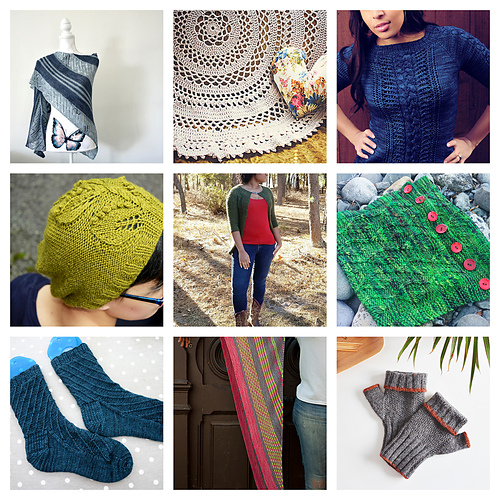
From left to right, top to bottom:
Are you with me?
*BIPoC: Black Indigenous People of Color

 D'NALI